Introduction
When your supplier tells you that an important shipment is late, your team has to check production orders and assess inventory issues, such as stockouts or poor replenishment. They have to promptly identify alternate suppliers, inform stakeholders, and update schedules. All while facing a deadline.
Should this entire process follow automation rules? Should AI evaluate the situation and suggest the next steps?
In this article, we’ll help you decide whether you should opt for traditional workflow automation, or agentic AI, or both for your business.
The right choice depends on your business. It depends on which technology can deliver the best value for you.
Comparing agentic AI with traditional automation
Before differentiating between the two, let’s understand them one by one.
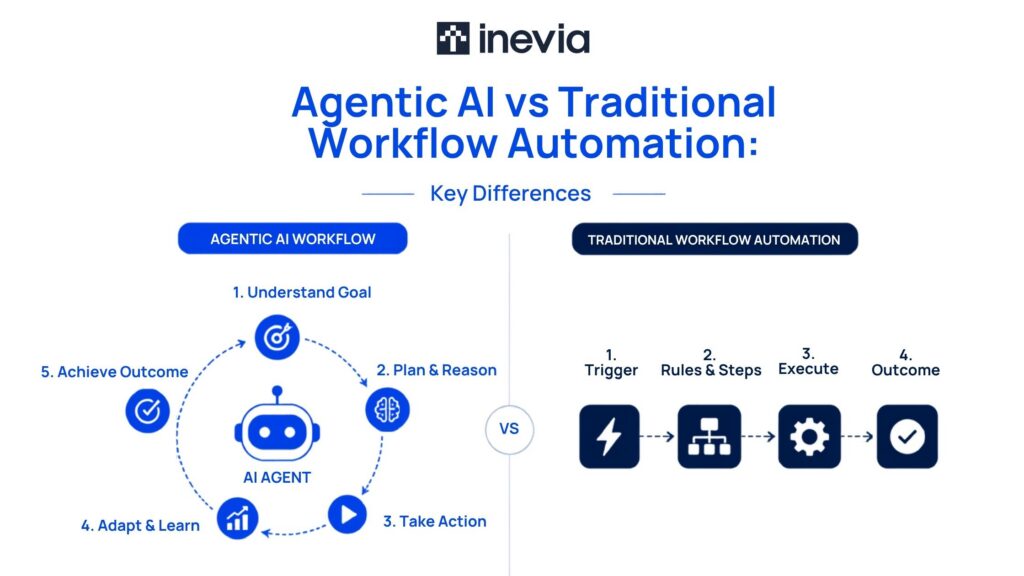
Traditional workflow automation executes predefined business processes. It follows fixed rules. Every step is designed in advance. This approach is ideal for predictable tasks and repetitive work.
On the other hand, agentic AI uses AI agents. These agents understand business context, extract information from different systems, and think through situations. Agentic AI can suggest actions or perform approved tasks to help you achieve your goals.
The main difference is explained below:
- Traditional workflow automation sticks to a predefined path.
- Agentic AI determines the ideal action based on available information. It functions within business rules and human-defined guardrails.
Five questions to help you choose
Before you choose between agentic AI and workflow automation, ask yourself these questions:
- Can all steps in my task be predefined?
- Does the process always have exceptions?
- Does my team need information from various systems before making a decision?
- Are human approvals needed?
- Is my business data connected, easy to access, and accurate?
If most of your answers confirm predictable and repetitive work, traditional workflow automation is the better option.
However, if your team spends a lot of time locating information, interpreting situations, and finalizing what to do next, agentic AI is the better choice.
Selecting the right approach for your business
To decide between agentic AI and workflow automation, visualize the process you’re doing and think how agentic AI or workflow automation could help. Here are some examples:
| Work Scenario | Suggested Approach |
| Each step is predefined and predictable | Traditional workflow automation |
| The next step relies on business context | Agentic AI |
| The process needs awareness of context before deciding and executing | Mix both approaches |
Rather than asking which approach is better, ask which one best supports the way you run your business.
When traditional workflow automation is better
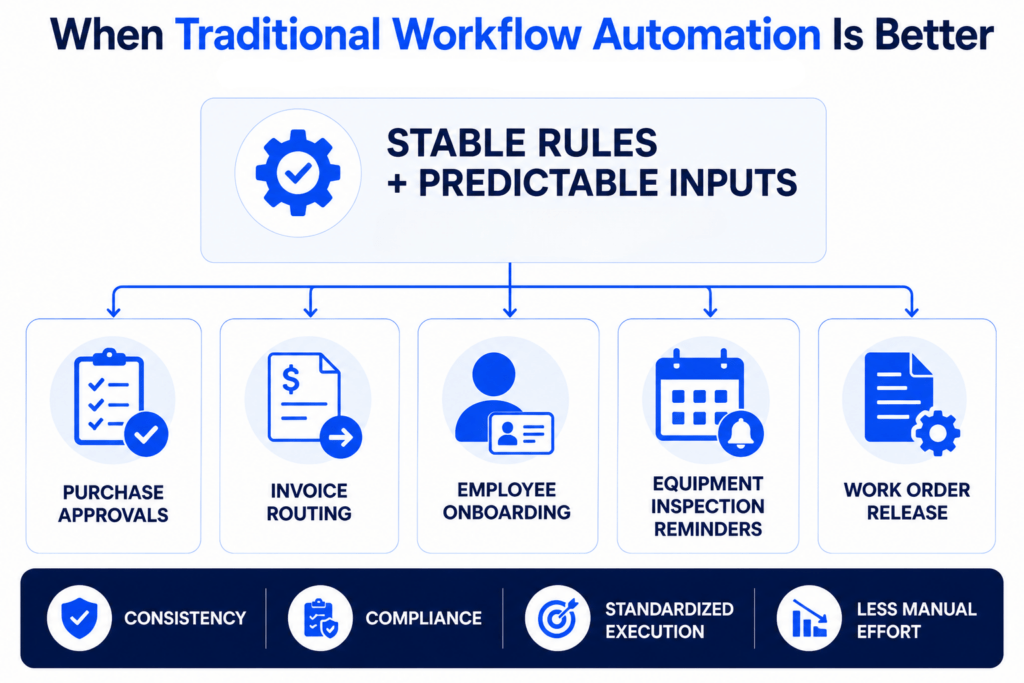
Traditional workflow automation is useful when your business rules are stable. If the inputs are predictable in nature, and if consistency is more important than flexibility, go for workflow automation.
Here are some cases where traditional automation does better:
- Approving purchase requests
- Routing an invoice
- Employee onboarding
- Sending reminders for equipment inspection
- Releasing work orders
For such tasks, you rarely need interpretation or business judgment. These tasks benefit from better compliance, standardized execution, and less manual effort.
If you think each and every workflow needs AI, think again. Traditional workflow automation is better for predictable actions and repetitive tasks. It’s simple and reliable too.
When agentic AI is better for you
Agentic AI is better for operations where each situation is different.
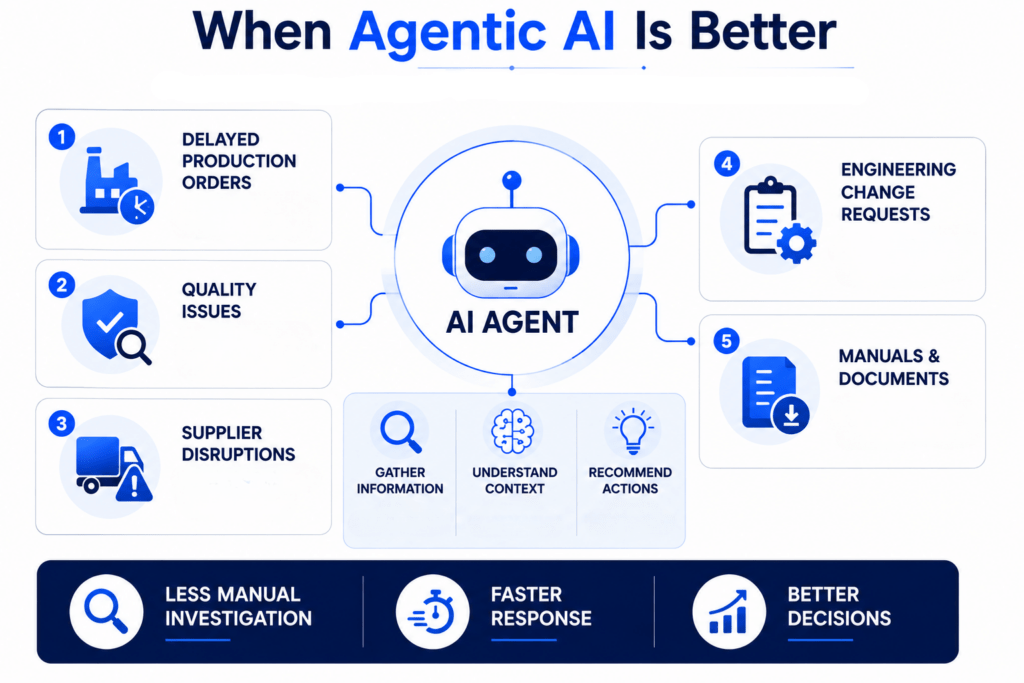
Instead of simply following rules, AI agents can extract information from your business systems. These agents can evaluate the situation, suggest actions, and involve your team whenever approval is needed.
Agentic AI is good for:
- Handling delayed production orders
- Investigating any quality issues reported
- Managing supplier disruptions
- Coordinating requests for engineering changes
- Retrieving information from manuals and documents
Agentic AI helps your employees make better decisions. It brings together the information they need. It reduces the need for manual investigation. It also accelerates response times.
So, if your employees spend a lot of time gathering information, interpreting the context, and coordinating tasks across various systems, go for agentic AI.
Using agentic AI with traditional automation
For your operations, you need not choose between workflow automation and agentic AI.
You can benefit from both.
Let’s say your shipment is delayed. An AI agent can review the inventory and evaluate production schedules. It can identify the affected work orders and suggest the best course of action.
Once your manager approves the recommendation, workflow automation can update your ERP system and keep your stakeholders informed. Workflow automation can assign new work orders and automatically record each action.
So, agentic AI helps you make better decisions, while workflow automation executes processes that are approved by you.
Both approaches can complement each other.
Automation maturity: From set rules to AI agents
You don’t always need a completely autonomous agent for your workflows.
Check where each process sits on the automation spectrum. This will help you avoid any unnecessary complexities.
| Level | Description | Example |
| Traditional workflow automation | Fixed business rules run each step | Inventory alerts |
| AI assisted workflow | AI supports each step of the workflow | Classifying documents |
| Agentic workflow | AI evaluates the context and gives recommendations | Investigation of production delays |
| Autonomous agent | AI plans and coordinates multi-step tasks | Procurement coordination |
Many organizations gain significant business value by using the first two levels before moving to advanced AI capabilities.
How to prepare your business for automation
Successful automation starts before implementing any technology.
- Understand the process
Document the current workflow in use. Include the decisions, system interactions, and handoffs among your teams.
- Improve the quality of your data
Make sure your business data is not just accurate but also standardized and accessible. Both workflow automation and AI agents are dependent on trusted sources of information.
- Connect your systems
Provide reliable access to ERP, MES, CRM, document repositories, and other operational systems.
- Establish a governance framework
Define the approval points, permissions, and business rules. Doing this will guide automated decisions and recommendations made by AI.
- Start with one valuable workflow
Select a business process that gives you measurable impact. Then you can expand automation across your organization.
How Inevia helps you run your business
Does every process need agentic AI? No. Should every workflow be based on rules? Not really.
At Inevia, we can help you evaluate your operational processes through a free audit. We identify opportunities for automation in your organization and determine where AI can deliver the greatest value for you.
If you run manufacturing, Inevia’s Traveler MES gives you production visibility and the operational data that supports workflow automation and AI powered decision making across your shop floor.
Frequently Asked Questions
What is the difference between agentic AI and RPA?
RPA, or Robotic Process Automation, follows predefined rules to automate any repetitive tasks. On the other hand, agentic AI interprets your data, reasons through each situation, and suggesting actions when predefined rules are not enough. In simple words, RPA executes, while agentic AI reasons.
Can traditional workflow automation evolve into agentic AI?
Yes. Many organizations extend their current workflows by introducing AI agents. These agents provide recommendations while preserving any existing automation processes.
Do all workflows need agentic AI?
No. Workflow automation is ideal for predictable and repetitive processes. Agentic AI is better for workflows that need sound judgement, business context, or data from different systems.
How to measure the ROI of agentic AI?
Check if there is any improvement in your workflow completion time or operational efficiency. Look for signs of improvement in decision quality, manual efforts, and employee productivity. Make sure you track desired outcomes like fewer delays, faster response times, and reduced errors.
What are AI agentic workflows?
An AI agent workflow is basically a multi-step process autonomous AI systems make use of reasoning and self-reflection to complete complex tasks with minimum human intervention. It combines predictable business automation with adaptive AI reasoning. It is dependent on many foundational capabilities to carry out tasks from the start to end. Read more: What Are AI Agent Workflows?
Try both for your business. Keep an open mind.
Traditional workflow automation and agentic AI solve different problems for your business.
Workflow automation ensures consistency by executing predefined business processes.
Agentic AI adds the angle of intelligence. It helps your teams interpret information, evaluate the context, and make sound decisions.
Hence, you don’t have to choose one over the other. You just need to understand where each approach works best for you.
When you combine reliable workflow automation with contextual AI, you go a step ahead in scaling your operations. You accelerate your journey toward AI readiness.
Still confused between workflow automation and agentic AI? Book a free meeting with Inevia to explore how both can help your business.