Let’s say you are an electronics manufacturer having an order for 430 units. Your sales team records this order in one application, while your warehouse department checks the stock in some other application.
Production planning uses a third platform, while your shipping team waits for confirmation that your order is ready.
This process might work for you. But if you notice, every handoff here depends on someone:
- Checking data
- Entering data
- Passing data
A better alternative? Systems integration. When the required systems are integrated, data can be moved automatically between your applications, eliminating the need for manual updates.
A systems integration strategy can help you run your operations better.
In PwC’s 2026 Digital Trends in Operations Survey, integration complexity was the most common reason given by operations and supply chain leaders for unsatisfactory technology investments. Among industrial products companies, 55% reported integration complexity as an issue.
This blog explains how your business can plan integrations around day-to-day processes to ensure data ownership and system reliability across the organization.
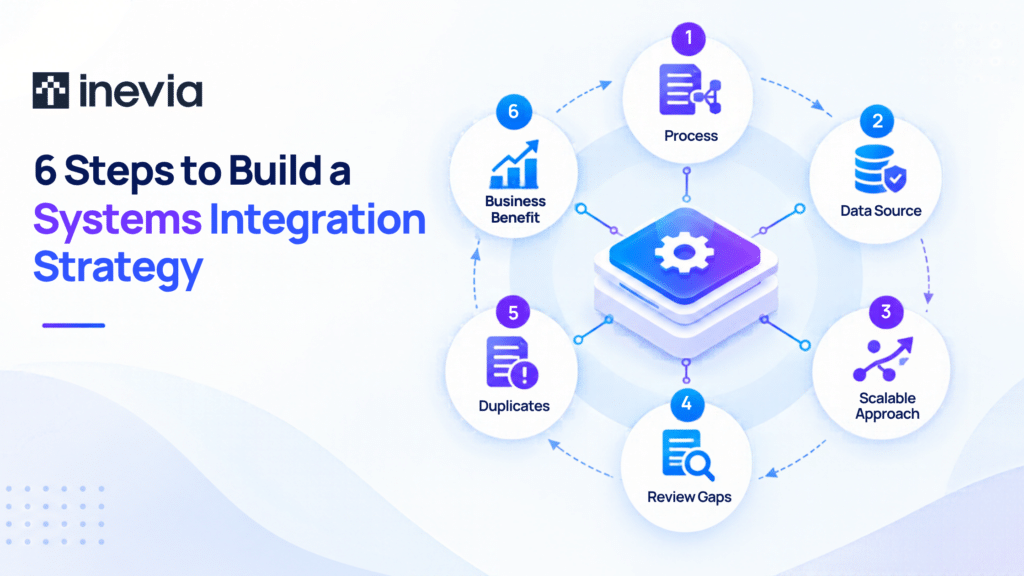
1. Select the Business Process to Integrate
A good systems integration strategy begins with a business process that could be carried out faster, without too many manual steps.
Let’s go back to the example of electronics manufacturing.
- The sales team receives the order.
- Your warehouse staff checks available stock.
- Your production planners schedule additional units as required.
- The shipping department prepares the final delivery.
What if the order details are typed again at each stage? Re-entering details of the order at every stage increases workload and also increases the risk of inconsistent data.
Let’s look at some other industries.
Education: Student details collected during admission can aid fee setup, class allocation, lecture attendance, and communication of announcements.
Legal services: Client details taken during intake can feed matter creation, document setup, time tracking, and billing processes.
Healthcare: Once a patient service is completed, the relevant service details can be moved to billing without having to do another manual entry.
Your systems integration strategy should focus on a business outcome, such as reducing order-entry time, speeding up billing processes, or reducing inventory reconciliation.
2. Define the Trusted Source for Data Records
Most businesses store the same type of data in more than one application. Customer names, stock quantities, product codes, or account status may appear across different systems.
It is better to define one trusted source for each important record.
Think of a small electronics business.
- Inventory quantities: The inventory application can hold the stock figure used by sales and warehouse teams.
- Product records: The product system can maintain approved item codes, descriptions, and specifications.
- Customer details: The sales platform can maintain approved contact and account information.
This setup proves helpful when two applications show different values. Your teams know which record should take priority. Employees don’t have to compare systems manually.
3. Choose an Integration Approach that can be Scaled
Many businesses begin with one connection between two applications. Over time, more software may need access to the same data.
Healthcare: A healthcare company might first connect appointment scheduling with billing. Later, payment status or patient communication may need data from the same process.
Retail: A retailer selling electronic products may connect online orders with inventory first. Shipping updates and customer notifications could follow later.
Reusable APIs, connectors, and shared data rules make these additions easier because the business does not need to build every integration from scratch.
This is also why integration architecture needs to be examined. A setup that works for two applications should not become difficult to manage when five or six systems need to communicate with each other.
4. Review the Entire Process for any Pending Manual Gaps
Connecting one part of a process can still leave manual work elsewhere.
In automotive manufacturing, an order may pass through these stages:
- The planning team receives the customer order.
- Material availability is checked before production is scheduled.
- Production teams complete the required work.
- Quality engineers inspect the parts.
- Shipping receives approval to release the order.
Suppose quality results reach production planning automatically, but the shipping team still waits for an email confirming final approval. One manual handoff remains, right?
A similar situation can occur in a law firm. Client intake may create a matter automatically, while billing staff still re-enter the same client details later.
Looking at the complete process helps industry leaders identify these gaps in processes before going ahead with systems integration.
5. Plan for Duplicate Records and Failed Transfers
Applications can become temporarily unavailable. Records may arrive with missing fields. The same transaction may be sent twice.
A systems integration strategy should include rules for handling such cases.
- Failed transfers: Keep a record of the failed transaction and retry it after the system becomes available.
- Duplicate transactions: Prevent the same update from creating two orders, invoices, or customer records.
- Invalid records: Flag missing or incorrect fields before the record enters another application.
- Critical failures: Assign responsibility for resolving issues that can affect production, customers, billing, or compliance.
For example, if an automotive quality system places an order on hold but the planning system does not receive the update, the responsible team should be alerted before more units are produced.
6. Measure the Business Benefit
Connected systems should ultimately help you improve a business result.
Some possible benefits are given below:
- Warehouse operations: Staff spend less time reconciling stock records.
- Healthcare: Completed services reach billing sooner.
- Automotive manufacturing: Quality holds reach planners faster.
- Electronics: Fewer orders need correction because of outdated stock data.
- Education: Student details are entered fewer times.
- Legal services: New matters are created faster after client approval.
These measures show whether the integration is reducing manual effort and helping your teams work faster.
Conclusion
A well-planned systems integration strategy helps businesses get more from the software they use today, while preparing for future applications.
Your systems integration strategy should start with a business process, establish trusted data sources, and account for future connections.
The strategy should take into account any possible failures or incorrect records that may occur. And defining the expected business outcome is a must.
A well-planned systems integration strategy can reduce routine data handling, improve coordination between departments, and make day-to-day operations easier to manage.
Looking for systems integration support? Contact Inevia to connect your software applications and improve operational processes.
FAQs
1. What is systems integration?
Systems integration connects separate software applications so they can exchange data automatically and support business processes. It reduces manual movement of data between systems.
2. What is a systems integration strategy?
A systems integration strategy is a plan for connecting business applications in a controlled and scalable way. It covers data ownership, integration methods, reliability, and expected business outcomes.
3. Which systems should a business integrate first?
Start with applications used in processes that involve repeated data entry, delayed updates, or conflicting records. These areas usually offer the clearest operational benefit.
4. Why is systems integration important for AI?
AI tools often depend on data stored across multiple business applications. Integration helps make that data more accessible and consistent for analysis, automation, and AI agents.