Quality Management
Quality management, in practice, is not about enforcing standards after problems occur. It is about ensuring quality holds up while work is actively moving through real operational constraints.
In manufacturing environments, quality breaks down when processes change, priorities shift, and issues surface too late to prevent downstream impact. A modern approach to quality management must operate inside daily execution, not outside it.
When quality is treated as a living system rather than a reporting function, it becomes easier to prevent defects, maintain consistency, and scale operations without increasing risk.

What Quality Management Really Means in Practice
At its core, quality management is the discipline of designing processes that consistently produce acceptable outcomes, even when conditions are imperfect. While quality is often associated with inspections and audits, real-world quality failures usually occur because:

Late Deviation Detection
Deviations are identified after production is complete

Disconnected Quality Data
Quality data is scattered across tools and teams

Assumed Root Causes
Root causes are assumed instead of traced

Manual Corrective Action Tracking
Corrective actions are tracked manually
A strong quality management system brings quality controls closer to where work happens, allowing teams to detect and correct issues before they escalate.
Why Most Quality Management Software Falls Short
Many quality management software solutions focus heavily on documentation and compliance reporting. They are built to record what happened, not to influence what is happening in real time.

In live production environments, quality issues emerge mid-process. When systems cannot respond immediately, teams often rely on manual workarounds.
- Spreadsheets used for temporary tracking
- Email chains for issue communication
- Verbal handoffs between teams
This disconnect creates a false sense of control. Leadership sees compliance metrics, while operational teams manage quality reactively—turning the system into a passive observer rather than an active control layer.
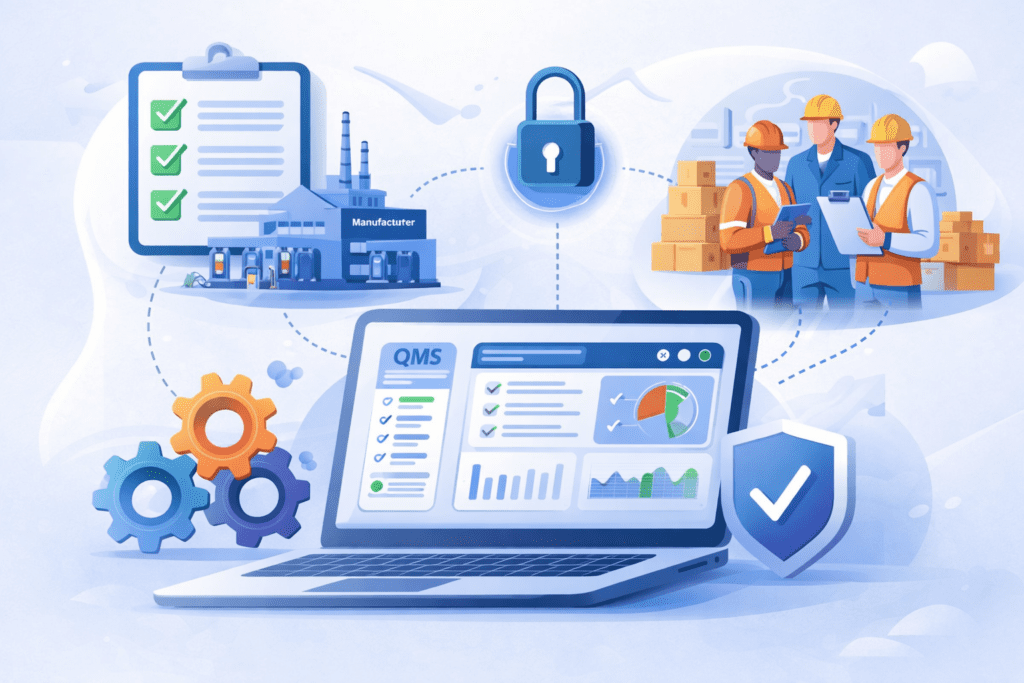
Scaling Quality Management Without Operational Overhead
As organizations grow, quality complexity increases. More suppliers, more product variants, and stricter compliance requirements introduce risk at every handoff.
The right quality control management software is designed to scale without increasing administrative burden. It enables multiple quality workflows to run in parallel while maintaining clear ownership, traceability, and accountability.
By centralizing quality processes and data, teams can maintain consistency across locations, shifts, and production lines without slowing down operations.
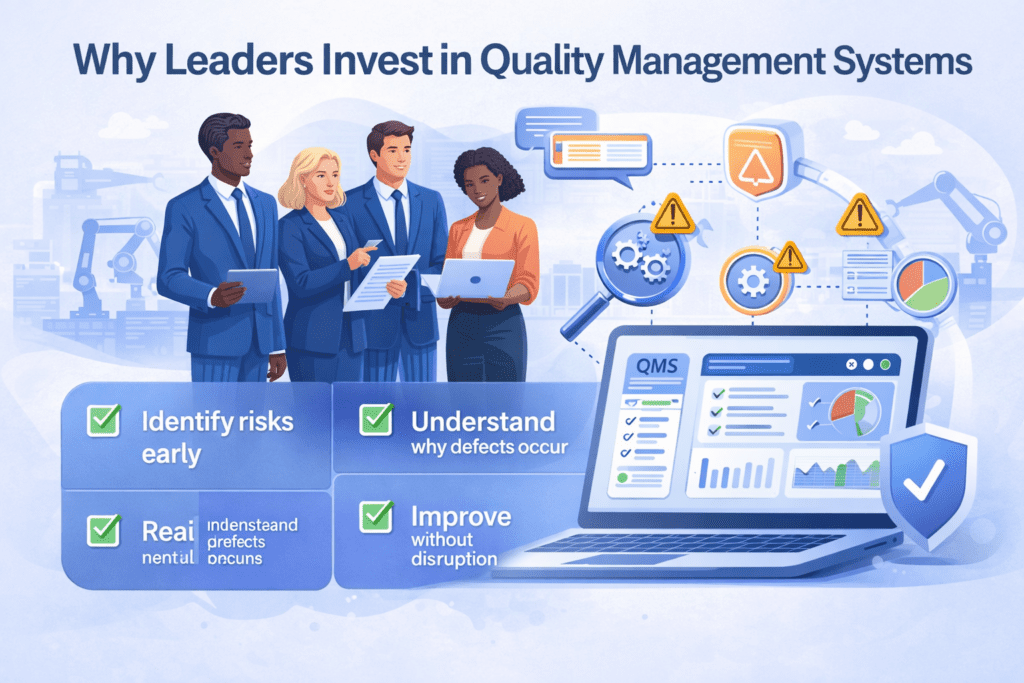
Why Leaders Invest in Quality Management Systems
For leadership teams, quality management is not about micromanagement. It is about confidence.
With the right quality management software, leaders can:
- Identify quality risks early
- Understand why defects occur, not just where
- Improve processes without disrupting throughput
This shifts quality conversations from reactive explanations to proactive improvement.
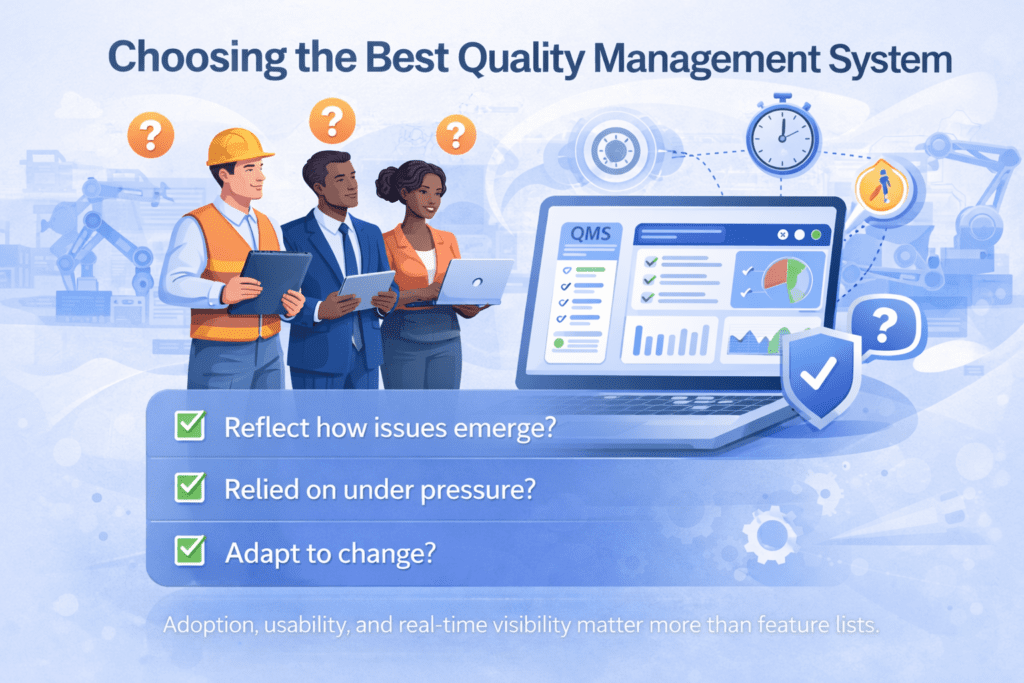
Choosing the Best Quality Management System
The best quality management system is not defined by the number of features it offers. It is defined by whether teams continue to use it when issues arise under pressure.
When evaluating quality management software, decision-makers should ask:
- Does this reflect how quality issues actually emerge?
- Will teams rely on it during live production?
- Can it adapt as processes and standards change?
Adoption, usability, and real-time visibility matter more than feature lists.

Quality Management Is a Long-Term Capability
Quality management is not a one-time implementation. It is a capability that strengthens as organizations learn from their own operations.
The most successful teams treat quality management as an evolving system, improving it through continuous use, feedback, and iteration. This approach separates systems that are ignored from systems that become operationally essential.
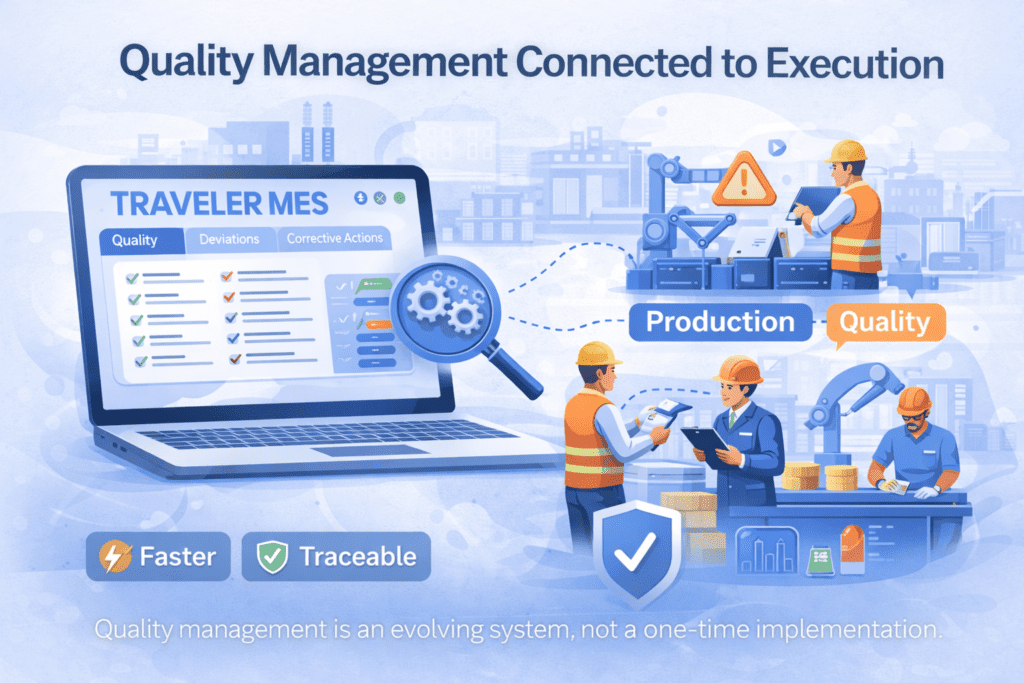
Quality Management Connected to Execution
Quality outcomes improve significantly when quality workflows are connected directly to manufacturing execution.
For example, aligning quality processes within a manufacturing execution environment such as Traveler MES allows inspections, deviations, and corrective actions to move in sync with production, rather than being tracked separately.
This alignment reduces lag, improves traceability, and ensures quality decisions are based on real-time operational context.
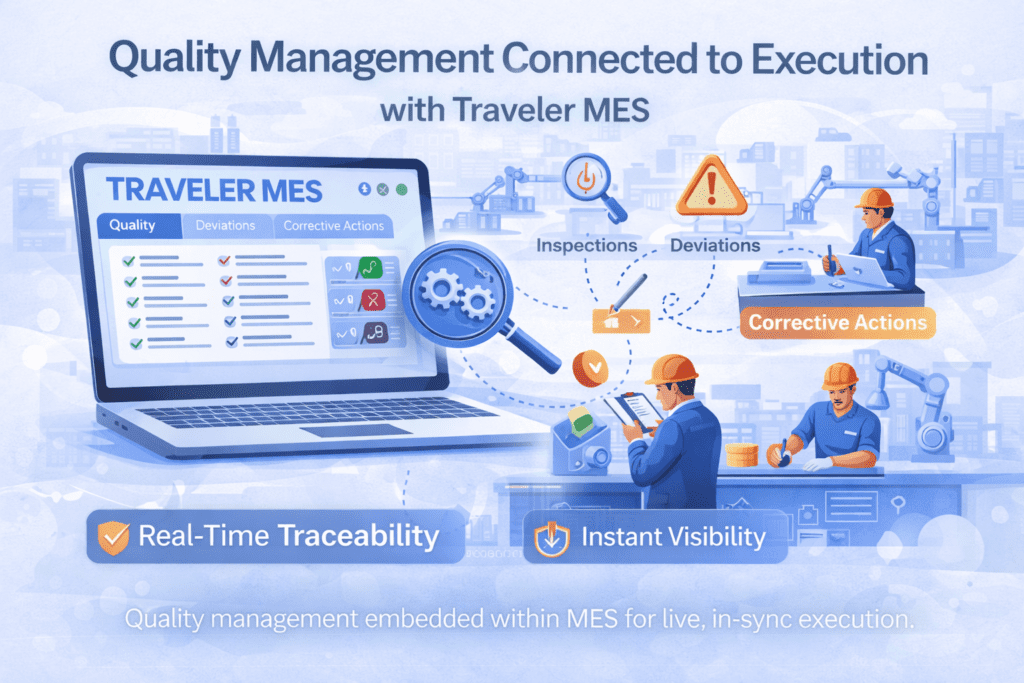
Quality Management Connected to Execution with Traveler MES
True quality management becomes possible when quality workflows move in sync with production execution. This is where Traveler MES plays a critical role.
By embedding quality management directly within Traveler MES, inspections, deviations, and corrective actions are tied to live production steps rather than tracked separately. Quality data updates in real time as work progresses, giving teams immediate visibility into issues as they occur.
This integration eliminates lag between production and quality decisions, improves traceability across orders and batches, and ensures quality management is driven by real operational context instead of after-the-fact reporting.
A Quality Management System Built Around Execution
An effective quality management system supports quality in motion, not just quality review. This means:
Embedded Quality Checks
Quality checks are embedded into process steps
Immediate Deviation Visibility
Deviations trigger immediate visibility
Root Cause–Linked Corrective Actions
Corrective actions are linked directly to root causes
Real-Time Production Quality Data
Quality data reflects current production status
Continuous Quality Guidance
Guides execution to reduce rework and prevent recurring defects.
Ready to Transform Your Manufacturing?
Discover how Traveler MES can streamline your operations and boost efficiency.
Get Started
When Quality Management Starts Driving Results
When quality management is integrated into execution, teams spend less time reacting and more time preventing. Organizations begin to experience:
-
Fewer Defects Fewer defects and non-conformances
-
Faster Issue Resolution Faster resolution of quality issues
-
Greater Operational Consistency Greater consistency across teams and facilities
Over time, quality management evolves from a compliance requirement into a measurable competitive advantage.
FAQs
Quality management is the practice of ensuring that products and processes consistently meet defined standards through prevention, control, and continuous improvement.
Quality control focuses on detecting defects, while quality management focuses on preventing them by embedding quality into processes.
Most companies rely on systems that document quality instead of enforcing it during execution, causing issues to surface too late.
Traveler MES supports quality management by embedding inspections, deviations, and corrective actions directly into production workflows, enabling real-time visibility and traceability.
Traveler MES ensures quality management operates in sync with execution, reducing delays, improving accountability, and preventing defects before they impact downstream operations.
Ready to Strengthen Your Quality Management?
If quality feels reactive, inconsistent, or overly dependent on manual checks, the problem isn’t effort. It’s the system behind it. Explore how modern quality management systems can bring visibility, control, and consistency back into daily operations by embedding quality directly into execution.
Contact Now