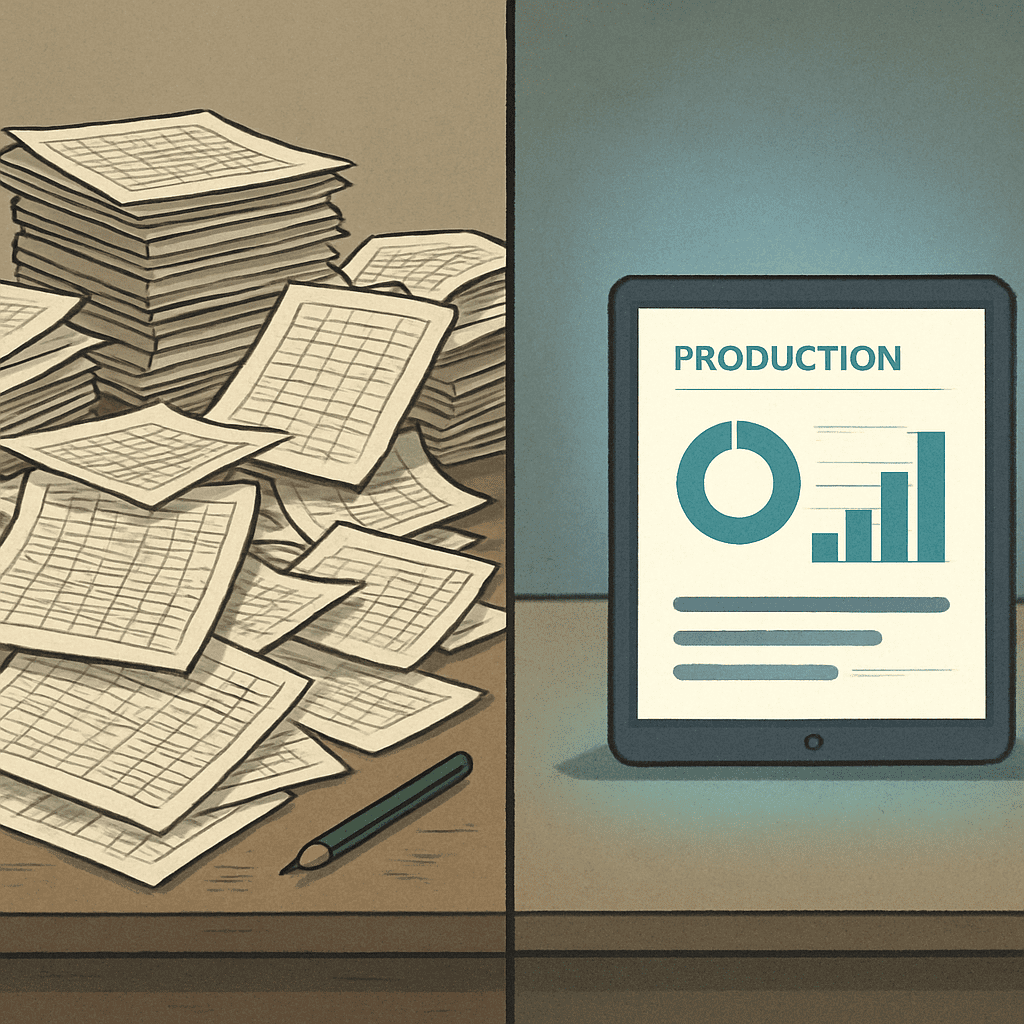
We track twenty-dollar pizza deliveries on our phones with pinpoint accuracy. Yet, according to common industry surveys, many managers still rely on clipboards and guesswork to track a twenty-thousand-dollar factory order. Imagine a production floor where every worker knows exactly what to do next, machines run smoothly, and nothing is wasted.
Bringing order to this chaos means closing the information gap between office planners and shop floor machines. If your business software acts as the brain making big-picture schedules, you might ask: exactly what is a manufacturing execution system? Think of it as the factory’s digital nervous system that actually moves the muscles.
Instead of waiting for an end-of-shift paper report to see what went wrong, leaders use real-time data capture to catch problems instantly. The real-time production monitoring benefits are immense, allowing managers to spot a missing part before it causes an expensive assembly line jam. Keeping a live pulse on operations prevents those frustrating daily bottlenecks.
Trading messy spreadsheets for digital tracking delivers a rapid return on investment through fewer errors and less stress. Finding the best manufacturing execution system requires looking at your specific goals and daily routines. Once installed, this software turns unpredictable workshops into profitable, well-oiled machines.
The ‘Head Chef’ of the Factory: Defining MES Through a Simple Kitchen Analogy
Imagine a bustling restaurant where the front-of-house host takes your reservation and plans the evening. It is the head chef, however, who actually shouts the tickets, times the steaks, and ensures your food arrives hot. In the industrial world, a Manufacturing Execution System (MES) plays the exact same role.
Instead of managing line cooks and fresh ingredients, an MES directs machines and factory workers. It translates a high-level business plan into physical action by focusing on three essential jobs:
- The Organizer (Scheduling): Telling everyone exactly what to build and when.
- The Watchman (Tracking): Functioning as shop floor data collection software to monitor real-time progress.
- The Inspector (Quality): Catching mistakes before a defective product leaves the line.
Building countable items like bicycles or smartphones- an industry known as discrete manufacturing- makes this oversight incredibly powerful. The system creates a “digital birth certificate” for every single product, permanently recording exactly which parts were used and who assembled them. Catching a missing screw early delivers real manufacturing process optimization, saving companies thousands of dollars in wasted materials.
Knowing how to perfectly cook the meal is crucial, but someone still needs to pay the rent, take customer orders, and buy the bulk ingredients. This separation of duties perfectly illustrates why your business brain needs a separate system to control physical production.
ERP vs. MES: Why Your Business Brain Needs a Central Nervous System to Move
Most owners use Enterprise Resource Planning (ERP) software as their business brain for handling financial orders and payroll. Yet, relying solely on that brain to run physical machines causes missing parts, panicked phone calls, and mysterious production delays. Grasping mes vs erp differences is straightforward: the ERP decides what needs to be made, while the MES acts as the central nervous system that actually builds it.
Information must flow instantly from the front office to the machines and back again. Manual paper logs create data latency- the costly delay between a factory mistake occurring and management finding out. This lag kills profit margins by ruining hours of raw materials before anyone notices. While basic sensors detect equipment issues, comparing scada vs mes functionality shows that the MES actually translates those raw machine alerts into immediate, corrective instructions for your workers.
Pairing both systems creates a perfect communication loop where front-office data drives automated inventory tracking and traceability solutions to stop errors instantly.
3 Features That Turn Raw Data into Real-Time Profit
Ever wonder how top factories know exactly how well they are running? They use a metric called Overall Equipment Effectiveness (OEE). Think of OEE as a “Factory Health Score” measuring speed, perfect products, and machine reliability. Tracking this score helps a best in class manufacturing execution system instantly spot profit leaks, like a conveyor belt running five percent too slow.
To boost that health score, factory managers rely on an essential feature checklist:
- Real-time Dashboards
- Automated Quality Gates
- Predictive Maintenance Alerts
Instead of workers waiting around for materials, smart production scheduling and dispatching features assign daily tasks automatically based on priority and machine availability. If predictive maintenance alerts detect a motor overheating before it breaks, the system immediately shifts the workload to another station. This proactive approach excels at reducing production downtime with software, turning what used to be a frantic factory emergency into a simple, scheduled repair.
Catching mistakes early also saves a fortune in materials. When automated quality gates block a flawed bicycle frame from entering the expensive paint booth, you avoid wasting resources finishing a ruined product.
Finding the Best Value MES: Solutions for Metal Fabrication and High-Tech Growth in 2026
Buying software for a factory is a lot like buying a suit: a custom fit always looks and works better than something bought off the rack. While “one-size-fits-all” software might seem easier initially, factories save far more money by choosing purpose-built solutions designed for their specific rules. For example, the best value manufacturing execution system for metal fabrication will include “out-of-the-box” tools- features that work perfectly right away without expensive custom programming- built specifically to track scrap metal and manage intense furnace temperatures.
Precision matters even more when building electronics or medical devices, where a tiny mistake can ruin a product. Therefore, the best manufacturing execution system for high-tech industries 2026 focuses heavily on strict compliance and tracing every tiny microchip back to its exact origin. These advanced systems prevent costly recalls by ensuring every step meets tight safety standards, acting as an automatic digital bodyguard for your brand’s reputation.
Global manufacturing hubs are already upgrading to meet these highly specialized demands. To stay competitive, factories seeking the best manufacturing execution system USA has to offer are prioritizing “Industry 4.0” readiness, where machines, software, and human workers seamlessly communicate in real time over the internet.
The Cloud-Based Revolution: Why Small Businesses No Longer Need Million-Dollar Budgets
Years ago, factory software required buying massive computer servers- an “On-Premise” setup only giant corporations could afford. Today, everything is shifting toward Software as a Service (SaaS). Think of SaaS like renting movies online instead of buying the DVD player; you simply log in and start working. This makes a cloud based mes for small business a highly affordable reality.
Browsing modern mes software reviews reveals why smaller factories are eagerly upgrading. The top mes solutions store data securely in the cloud, crushing the myth that off-site servers are unsafe- they actually utilize world-class security teams that outmatch local backroom servers. This modern model brings three distinct advantages:
- Lower upfront cost: You pay an affordable monthly subscription instead of buying expensive hardware.
- No server maintenance: The software provider handles all the complicated technical updates.
- ‘Work from Anywhere’ visibility: Managers can check production speeds live from their phones.
Scaling becomes effortless because you can expand from monitoring one machine to an entire floor without installing new hardware.
The 5-Step Selection Guide: How to Pick an MES Provider That Won’t Outgrow Your Team
Figuring out how to choose an mes provider starts with focusing on the people actually using it. Many buyers fall into the trap of “Feature Bloat”- paying for hundreds of complex tools they will never use. Instead, prioritize a clean User Interface (UI), which is simply the digital screen your workers tap. If the UI looks as confusing as an airplane cockpit, your team will resist it.
Once you find a system your team likes, the financial math needs to make sense. When evaluating manufacturing software roi (Return on Investment), the easiest method is comparing “Paper-Time” to “Digital-Time.” Calculate the hours your team spends hunting down paper work orders or fixing manual counting errors, then multiply that by their hourly wage. A good system pays for itself just by eliminating this hidden administrative waste.
Protecting that investment means avoiding “Vendor Lock-in”- a situation where a software company traps your factory’s data so you cannot easily switch to a competitor. To keep your business safe, use The ‘Vendor Litmus Test’ by asking these 5 questions before signing:
- Can we easily export our production data if we leave?
- Is live customer support included in the base monthly price?
- Will this connect smoothly with our current business accounting tools?
- Do you charge extra fees for regular software updates?
- Can we run a small trial before committing?
Securing clear answers guarantees you select the best manufacturing execution system software for your real-world needs and sets a strong foundation for deployment.
Moving from Clipboards to Computers: 4 Steps to a Smooth MES Implementation
Rushing a software transition is a guaranteed recipe for a factory shutdown. Before beginning your manufacturing execution system implementation steps, you must organize your existing information. If old clipboards hold incorrect inventory counts, moving them into new software just creates faster mistakes. This is known as “Garbage In, Garbage Out” (GIGO). Set realistic timelines to clean your data first, ensuring your new system is built on a flawless foundation.
Next, test the waters using a Pilot Program on a single production line. Just like a restaurant trying a new dish on a few tables first, this small trial run prevents costly disruptions. It allows you to safely test new tools like automated quality control systems to catch physical product defects early without stopping the whole factory.
How do you get hesitant staff to embrace these updates? Find your “Internal Champions”- respected floor workers who learn the software first and guide their peers. When employees see a trusted coworker easily navigating this Industry 4.0 smart factory integration, they drop their resistance.
Your Smart Factory Action Plan: How to Start Small and Scale Fast
You no longer have to view factory upgrades as a daunting mystery. Because you now understand how shop floor data collection software tracks every part and process, you can approach vendors as a confident, informed buyer. Remember, digital transformation is an ongoing journey of steady improvements, not a single overnight purchase.
Start your journey today with this 30-Day ‘Digital Readiness’ Checklist:
- Audit paper logs to see exactly where your team loses time.
- Identify the ‘bottleneck’ machine slowing down your overall production.
- Request software demos from providers to compare solutions.
We track our pizza deliveries in real-time; your production line deserves that same clarity. Finding the best manufacturing execution system means securing a platform that integrates seamlessly with your supply chain tools and keeps operations running efficiently. Take these simple steps now, and steadily evolve your business into a true smart factory.