A rugged computer manufacturer builds systems with processors, fabricated enclosures, and many other smaller components. Before an order reaches assembly, its material team knows the required quantity of each part, the availability status in stores, and what is due from suppliers.
Which system helps manufacturers make those calculations across part numbers?
It is done by Material Requirements Planning, or an MRP.
MRP gives production and purchasing teams a dated view of material demand. It helps them prepare for upcoming work orders without relying on inventory totals alone.
Explore how MRP works for manufacturers, the associated pros and cons, and the changes AI is bringing to material planning in factories.
What Is MRP?
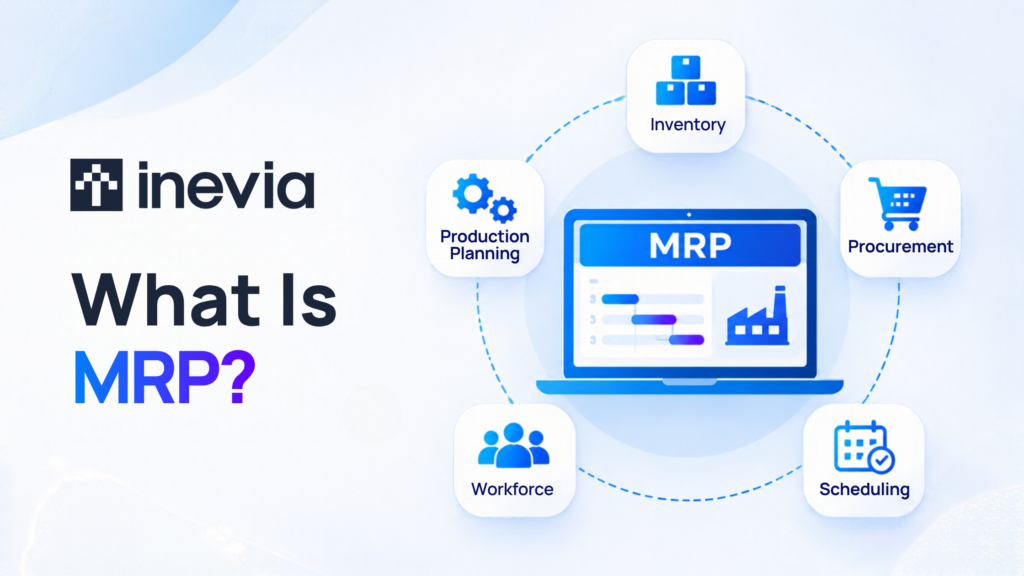
MRP, short for Material Requirements Planning, is a method for calculating the components and raw materials required to meet a production schedule.
With an MRP, manufacturers can understand:
- Which parts and materials are required
- How many parts are required
- By what date should they be available
How Does MRP Work?
Suppose an electronics plant schedules 200 control units. Each unit requires four connectors, creating demand for 800 connectors.
If 140 connectors are available and 80 more are due on an existing purchase order, another 220 are required. If their supplier’s lead time is three weeks, MRP calculates when purchasing should release the next order.
The same calculation runs through every level of the product structure, from finished assembly to subassembly to individual purchased parts.
MRP Inputs and Outputs
MRP cannot calculate material requirements from a production quantity alone. It combines production dates with product and inventory records.
Main Inputs of MRP
Master Production Schedule (MPS): MPS lists the finished products scheduled for production, their quantities, and required dates.
Bill of Materials (BOM): BOM lists the components and subassemblies used to manufacture each product.
Inventory records: These records show usable stock, allocated material, open purchase orders, scheduled receipts, and supplier lead times.
Main Outputs of MRP
With a Material Requirements Planning system in place, manufacturers can facilitate the following:
- Purchase orders for externally sourced components
- Manufacturing orders for parts produced internally
- Quantities and required dates
- Recommendations to bring an existing order forward or push it back
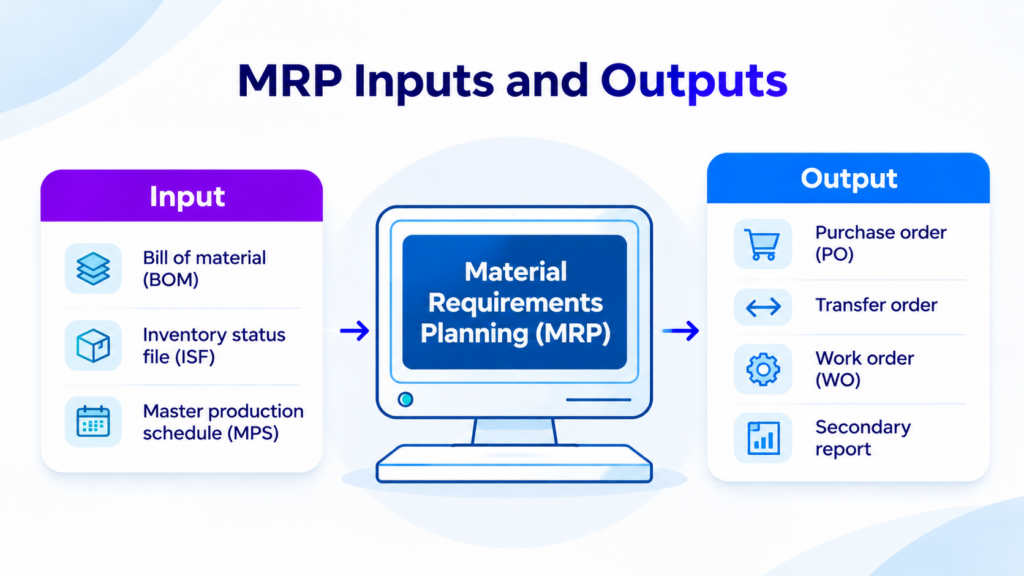
MRP calculates component demand from the production plan. For example, if the plan is to build 100 rugged computers, and each computer needs one processor and eight fasteners, MRP calculates a requirement for 100 processors and 800 fasteners.
Benefits of MRP for Discrete Manufacturers
The effect of good MRP planning can be seen across planning, purchasing, inventory, and production processes. Some of the main benefits are listed below:
- Shortages Are Visible Beforehand
A material planner can see that the bearing required next month will run short even if today’s stock level looks sufficient. Purchasing therefore gets time to place an order before the shortage affects production.
- Buyers Get Clearer Priorities
Ten parts may be below their preferred stock level, but only two may be required for work orders scheduled this week. MRP helps the purchasing team focus first on components tied to near-term production.
- Inventory Can Follow Production Demand
Materials do not need to arrive months before they are used. Ordering materials closer to required dates can reduce excess inventory and carrying costs.
- Work Orders Have Better Material Support
Material Requirements Planning helps production supervisors check component availability before releasing an order to the shop floor.
Manufacturers continue to invest in the systems supporting these decisions. According to Rootstock’s 2026 State of Manufacturing Technology Survey, 61% manufacturing leaders planned to increase enterprise software spending during the following 12 months.
MRP Pros and Cons:
| Pros | Cons |
| Enhances production | Can break easily |
| Reduces work in progress | Less compatible with small enterprises |
| Improves accuracy | Needs precise data |
| Can reduce the cost of manufacturing | Needs a strict production schedule |
What are the Limitations of MRP?
MRP calculations can be mathematically correct, yet operationally wrong. Some of its limitations are explained below:
Incorrect Stock Creates False Availability
If inventory records show 200 motors but only 160 are physically available, MRP treats 40 nonexistent motors as usable stock.
BOM Errors Multiply with Production Volume
A BOM calling for four brackets instead of five creates a shortage of 500 brackets on a 500-unit production order.
Supplier Lead Times Change
A component may still carry a 14-day lead time in the system even though the supplier now takes 21 days. The planned order date will therefore be too late.
MRP Does Not Confirm Factory Capacity
What if every component is ready, but the CNC machine needed for the first operation is fully loaded?
MRP primarily establishes material requirements. Capacity planning, production scheduling, MRP II, and MES address other constraints such as machines, work centers, labor, and production progress.
AI Advancements in MRP
Traditional MRP depends heavily on recorded values. AI can analyze the history behind those values.
More Realistic Supplier Lead Times
Instead of accepting a standard 14-day lead time, AI can analyze previous deliveries and identify suppliers or parts that regularly arrive late.
Better Demand and Inventory Decisions
AI can also analyze demand patterns, inventory consumption, supplier performance, and shortage history to support demand forecasting, inventory optimization, and supply planning.
McKinsey’s 2025 Supply Chain Risk survey found that only 19% of surveyed companies were deploying AI tools at scale, although demand forecasting, inventory optimization, and supply planning were among the leading supply-chain AI applications.
Despite using MRP, the production planner still decides whether a late component justifies expediting, rescheduling a work order, approving a substitute part, or using available stock for a higher-priority customer order.
Conclusion
MRP helps discrete manufacturers understand if every required component will be available when the work order needs it.
Accurate BOMs, inventory records, purchase orders, and supplier lead times allow MRP to turn upcoming production into clear purchasing and manufacturing requirements.
For manufacturers managing various part numbers and simultaneous orders, improved visibility through MRP can translate to fewer material shortages, better purchasing decisions, and production schedules backed by component availability.
Inevia can support this environment through operations data cleanup, system integration support, and AI workflows that help manufacturers use current production data in planning decisions.
Frequently Asked Questions
1. What is the difference between MRP and MPS?
The Master Production Schedule (MPS) specifies which finished products should be produced, in what quantities, and by which dates. MRP uses that schedule to calculate the components and materials required to complete those production orders.
2. What is the difference between MRP and ERP?
MRP focuses on material requirements for production. ERP covers a wider range of business activities, including purchasing, inventory, finance, sales, and manufacturing. Many manufacturing ERP platforms include MRP functionality.
3. Can MRP help prevent material shortages?
Yes. MRP compares upcoming production requirements with available inventory, scheduled receipts, and supplier lead times. This can show production planners and buyers where a component may run short before the work order reaches production.
4. What types of manufacturers use MRP?
MRP is widely used by discrete manufacturers that build products from defined components and BOMs. Examples include electronics, aerospace components, automotive parts, industrial machinery, medical devices, and rugged computer manufacturing.