Sustainability and MES: How Smart Execution Systems Cut Waste, Energy Use and Costs Without Slowing You Down

Sustainability and MES once meant compliance. It focused on meeting regulations, submitting reports, and ensuring operations passed audits. Today, sustainability is directly tied to efficiency, profitability, and long-term resilience. Manufacturers are expected to produce more with fewer resources, reduce waste without compromising output, and manage rising energy costs while staying competitive.

These challenges cannot be solved through effort alone. They require visibility into what is actually happening on the shop floor and the ability to act on that information in real time. This is where a modern Manufacturing Execution System, or MES, becomes essential. Sustainability improves not because teams work harder, but because they can finally see clearly and execute precisely.

The Real Sustainability Challenge on the Shop Floor

Waste and energy loss rarely happen because teams do not care. They happen because manufacturing environments are complex and often disconnected. Data lives in silos, feedback is delayed, and decisions are made without full context.

In many plants, scrap is discovered only during final inspection. Rework occurs because instructions were unclear or outdated. Machines continue running and consuming power while waiting for materials or approvals. Operators rely on experience instead of real-time data to make decisions.

These inefficiencies may seem small in isolation, but over time they compound into significant cost and environmental impact. A modern MES addresses this challenge by connecting people, machines, materials, and processes into a single execution layer that supports informed decisions at the exact moment they matter.

MES as the Foundation of Sustainable Manufacturing

An MES acts as the digital backbone of production operations. It ensures that what is planned is executed correctly, consistently, and efficiently on the shop floor. For small and mid-sized discrete manufacturers, systems like Traveler MES by inevia provide enterprise-level visibility and control without unnecessary complexity.

By capturing real-time production and quality data, MES platforms help manufacturers reduce waste and energy use as part of daily operations. Sustainability and MES is no longer a separate initiative or afterthought. It becomes embedded into how work is executed every day.

Reducing Material Waste Through Better Execution Control

Material waste is one of the most visible and costly sustainability challenges in manufacturing. Scrap and rework consume raw materials, energy, and labor while creating no additional value.

Digital work instructions and standardized execution

MES reduces material waste by bringing structure and consistency to execution. Digital work instructions ensure that every operator follows the same approved process, regardless of shift or experience level. This reduces variability and prevents common execution errors.

In-process quality checks and real-time alerts

In-process quality checks further limit waste by identifying defects as soon as they occur. Instead of discovering problems at the end of production, teams can correct them immediately. Real-time alerts help supervisors intervene before issues escalate.

Over time, manufacturers see:

  • Lower scrap and rework rates
  • Reduced raw material consumption
  • Fewer rejected lots
  • Less energy spent on producing unusable output

Producing the right part the first time is one of the most effective Sustainability and MES strategies available.

Cutting Energy Waste Through Real-Time Production Visibility

Energy consumption in manufacturing is often treated as fixed, but much of it is driven by operational behavior. Idle machines, inefficient scheduling, and unbalanced workloads contribute significantly to unnecessary energy use.

Machine Utilization and Idle Time Visibility

MES provides real-time visibility into machine utilization and production flow. Teams can quickly identify when equipment is running without producing value and adjust schedules accordingly. Production sequencing can also be optimized to reduce frequent start and stop cycles, which consume excess energy.

Supervisors gain access to dashboards and performance metrics that highlight inefficiencies and long-term trends. Over time, this insight helps reduce energy consumption per unit produced and supports more efficient use of power across shifts and lines.

When energy usage is connected directly to execution data, it becomes measurable and controllable.

Continuous Improvement That Makes Sustainability and MES Scalable

Sustainability and MES cannot be achieved through one-time fixes. It requires continuous improvement driven by reliable data and feedback.

Data-Driven Performance Tracking

MES supports this process by collecting detailed production, quality, and performance data over time. Teams can identify recurring bottlenecks, inefficiencies, and sources of waste by comparing performance across shifts, products, and production lines.

Because MES tracks the impact of changes, improvement initiatives can be measured and refined. Decisions are based on evidence rather than assumptions. Over time, small improvements accumulate into meaningful reductions in waste, energy use, and operating costs.

This data-driven approach ensures Sustainability and MES efforts are practical, repeatable, and scalable.

Traceability That Supports Responsible Manufacturing

Sustainability and MES also involves accountability and transparency. Manufacturers need to understand how materials are used, how products move through production, and where issues originate.

End-to-End Production and Material Traceability

MES provides end-to-end traceability by recording key production details such as:

  • Material usage and consumption
  • Process steps and machine activity
  • Operator actions and timestamps
  • Quality outcomes and deviations

This centralized record supports regulatory compliance, sustainability reporting, and faster root-cause analysis. It also allows manufacturers to demonstrate responsible practices to customers, partners, and stakeholders with confidence.

Traceability ensures Sustainability and MES efforts are backed by data, not assumptions.

Optimizing Resources Without Overburdening Teams

Effective Sustainability and MES balances machines, materials, and people. MES helps manufacturers optimize resource utilization without increasing pressure on the workforce.

By aligning workloads with actual capacity and reducing manual coordination, MES creates more predictable and stable operations. Operators work with clear instructions and timely feedback. Machines run more efficiently, and materials are used intentionally.

Sustainable manufacturing is not only about reducing environmental impact. It is also about building operations that are resilient, efficient, and humane.

Why MES Turns Sustainability into a Competitive Advantage

When Sustainability and MES are embedded into daily execution, it becomes a source of operational strength rather than a cost center. MES enables manufacturers to reduce waste, lower energy consumption, and improve productivity at the same time.

With real-time visibility and structured execution, sustainability becomes part of how work is done every day. Manufacturers no longer need separate initiatives to become more sustainable. They need better execution supported by the right digital systems.

Building Sustainable Manufacturing Through Smarter Execution

Sustainable manufacturing is built through everyday decisions on the shop floor. When manufacturers have real-time visibility, standardized execution, and reliable data, sustainability becomes a natural outcome rather than an added responsibility.

Manufacturing Execution Systems play a critical role in this shift. By reducing material waste, improving energy efficiency, enabling continuous improvement, and strengthening traceability, MES helps manufacturers operate with greater intent and accountability. Systems like Traveler MES support this transformation by embedding sustainability directly into how production is planned, executed, and improved.

As manufacturing continues to evolve, the organizations that succeed will be those that align efficiency with responsibility. Smarter execution leads to lower waste, better energy usage, and more resilient operations. With the right MES in place, sustainability becomes a competitive advantage built into the core of manufacturing operations.


Cloud-Native MES: Why U.S. Manufacturers Are Moving Off Premises

In factories across the U.S., something big is changing. Clipboards are being replaced by dashboards. Machine data flows not through cables, but through the cloud. The shift isn’t just technological; it’s strategic.

The modern U.S. manufacturer is chasing agility, scalability, and insight. And right at the center of this transformation lies the Manufacturing Execution System (MES), the digital core that synchronizes people, machines, and production in real time.

For years, MES platforms lived on-premises tied to local servers, expensive IT upkeep, and siloed data. But as production networks expand, costs rise, and hybrid teams become the norm, a new generation of MES has taken over: cloud-native MES.

Unlike older systems that were merely “lifted and shifted” to a remote server, cloud-native platforms like Traveler MES are designed from day one to live, breathe, and evolve in the cloud.

What Is a Cloud-Native MES?

Imagine your MES not as a heavy system bolted to your plant floor, but as a connected, flexible network that grows with your business. That’s the essence of a cloud-native MES built using microservices and APIs that exist entirely in the cloud, enabling real-time visibility across multiple plants, lines, and shifts.

In simpler terms, it’s not your old MES just sitting on a virtual server. It’s an ecosystem engineered for speed, scale, and continuous improvement.

Here’s what defines a true cloud-native MES:

  • Scalability: Add or remove plants and production lines with ease.
  • Resilience: Continuous uptime and automatic recovery.
  • Integration readiness: Plug seamlessly into ERP, IoT, and analytics platforms.
  • Security by design: Role-based access and end-to-end encryption.
  • API-first architecture: Ensures modular updates without downtime.

Traveler MES, for instance, was designed around these principles offering U.S. manufacturers a system that adapts to them, not the other way around.

Why U.S. Manufacturers Are Moving Off-Premises

This shift cloud-native MES isn’t theory. It’s happening across automotive, aerospace, electronics, and precision engineering plants. And it’s being driven by five key factors:

1. Cost and Infrastructure Pressures

Running local servers and managing IT infrastructure is costly and rigid. Every upgrade requires hardware, technicians, and downtime. With cloud-native MES, manufacturers switch from CAPEX to OPEX, paying only for what they use,and never worrying about obsolete servers again. 

2. The Agility Imperative 

The pandemic revealed a hard truth: manufacturing can’t afford silos anymore. When plants shut down, remote access became a survival need. Cloud-native MES platforms allowed teams to monitor KPIs, quality alerts, and performance dashboards from anywhere, keeping operations moving when it mattered most.

3. Multi-Site and Supply-Chain Visibility

Many U.S. manufacturers now run distributed operations from Ohio to Mexico to Southeast Asia. A cloud-native MES centralizes visibility, offering leadership a unified view of productivity, bottlenecks, and quality across sites.

4. Faster Deployment & Continuous Improvement

Legacy MES implementations could take months or years to roll out. Cloud-native platforms deploy in weeks, with continuous updates that enhance performance and security, no lengthy IT tickets, no disruption.

5. Data-Driven Decision Making

Data is the new raw material. Cloud-native MES brings all operational data into a single environment, enabling analytics that fuel predictive maintenance, quality optimization, and performance benchmarking.

Cloud-Native vs. Cloud-Hosted MES: The Big Difference

Here’s the truth most overlooked: putting a legacy MES on a cloud server doesn’t make it cloud-native it only makes it hosted.

FeatureCloud-Hosted MESCloud-Native MES
ArchitectureLegacy system hosted on a virtual serverBuilt with microservices for cloud environments
ScalabilityLimited, manual setup for new plantsAutomatic scaling and provisioning
UpdatesManual, scheduled downtimeContinuous deployment and updates
IntegrationComplex, IT-heavyAPI-first, plug-and-play
Cost ModelHigh CAPEX + maintenanceOPEX subscription, pay-as-you-scale
ExampleRe-engineered legacy MESTraveler MES, Pico MES

Key Benefits of Cloud-Native MES for U.S. Manufacturers

1. Real-Time, Multi-Plant Visibility

Manufacturers can now view OEE, quality, and throughput across every facility from a unified dashboard. Traveler MES makes this possible by offering cross-plant analytics that pinpoint inefficiencies in minutes not hours.

2. Rapid Scalability

Expanding to a new state or adding a production line? Cloud-native MES scales automatically, letting teams replicate proven workflows without additional IT overhead.

3. Lower Total Cost of Ownership

No more servers, local maintenance, or manual patching. Manufacturers using Traveler MES report significantly reduced operational costs within the first year of adoption.

4. Seamless Integration

Modern MES like Traveler MES integrate easily with ERP, IoT sensors, AI tools, and quality systems, enabling one connected manufacturing ecosystem.

5. Continuous Improvement through Data

Access real-time KPIs, traceability reports, and operator logs that fuel process optimization essential for lean and Six Sigma practices.

6. Enhanced Security and Compliance

Top-tier cloud infrastructure comes with advanced security certifications (SOC 2, ISO 27001). Traveler MES adds role-based permissions and secure audit trails that meet FDA 21 CFR Part 11 and ISO 9001 standards.

Addressing Common Concerns

Even with these advantages, some manufacturers hesitate. Let’s address the key concerns:

Concern 1: “What about data security?”
Cloud security has matured far beyond traditional setups. Traveler MES uses end-to-end encryption, MFA, and geo-redundant backups, ensuring uptime and compliance at every level.

Concern 2: “What if connectivity drops?”
Traveler MES bridges this with offline caching and hybrid edge connectivity, so production continues uninterrupted even with unstable internet.

Concern 3: “Can we still customize?”
Absolutely. Modern MES platforms are modular and configurable. Traveler MES offers role-based dashboards and workflow templates that fit each manufacturer’s unique environment.

Traveler MES: Powering the Cloud-Native Revolution

Traveler MES was built on a single idea: manufacturing data should flow freely, securely, and instantly.

Unlike traditional MES tools that struggle with scalability, Traveler MES offers a true cloud-native architecture designed for U.S. manufacturers that need speed, insight, and flexibility.

Traveler MES empowers manufacturers to:

  • Access real-time dashboards across every facility.
  • Monitor work orders, traceability, and quality in one interface.
  • Eliminate paper-based processes with digital traveler records.
  • Connect operators, machines, and managers seamlessly.
  • Achieve smarter, faster decision-making without IT bottlenecks.

Whether you’re scaling your production footprint or integrating AI-driven analytics, Traveler MES lays the digital foundation for intelligent manufacturing.

Making the Move Seamless

Moving from an on-premise to a cloud-native MES doesn’t have to be disruptive.
Here’s a simple roadmap for U.S. manufacturers:

  1. Audit your current MES infrastructure:  Identify which modules are critical (production, quality, maintenance, traceability).
  2. Define success metrics: Align MES KPIs with business outcomesOEE improvement, downtime reduction, faster NPI (new product introduction).
  3. Choose a partner, not just a vendor: Work with providers like Inevia (Traveler MES) who support phased migration, integration, and training.
  4. Start with a pilot site: Validate performance improvements before scaling enterprise-wide.
  5. Train teams for adoption:  Ensure operators and supervisors understand digital workflows and dashboards.
  6. Iterate and expand:  Once results are visible, roll out across additional sites.

The Future of MES Is in the Cloud

Manufacturing is no longer confined by walls or servers. It’s defined by data flowing freely, securely, and intelligently. As U.S. manufacturers chase global competitiveness and sustainability, cloud-native MES systems like Traveler MES are becoming not just an advantage, but a necessity.

Because the factory of the future isn’t bound to a location, it’s connected by information, powered by insight, and built on the cloud.

How Downtime is minimized by Traveler MES

In small and mid-sized factories, time isn’t just money; it’s reputation, customer satisfaction, and operational momentum. One small delay can trigger a domino effect, stalling production lines, missing deadlines, and stretching costs beyond control.

For discrete manufacturers who rely on precision, traceability, and timely delivery, these delays can be costly in more ways than one. But what if downtime wasn’t just monitored after the fact, but prevented altogether?

Traveler MES by Inevia is built specifically to tackle these challenges from the ground up. Not only does it align with your production workflow and it actively improves it, helping you reduce downtime at every critical point in your cycle.

Why Downtime is More Than Just Lost Time

In discrete manufacturing, every part is unique, every batch has a story, and every process must follow a strict sequence. When production stops, you don’t just lose minutes you lose trust.

Downtime can come from:

  • Miscommunication between teams
  • Missing or incomplete instructions
  • Poor visibility into where a product is in its cycle
  • Unlogged quality issues
  • Delays in raw material prep or inspection

These aren’t just technical hiccups, they’re blockers to operational efficiency. They slow your team, stress your delivery timelines, and weaken your competitive edge.

The Hidden Costs of Production Delays

You might not always see the numbers, but they’re there.

  • Idle time: Machines wait, people wait, orders wait.
  • Confusion and rework: Operators miss steps due to outdated instructions.
  • Delayed shipments: One late order means a missed customer window.
  • Wasted materials: Without clear tracking, you might scrap parts that could’ve been fixed.

For small and mid-sized businesses where resources are tight, these losses hit harder. Traveler MES helps you cut through the noise and focus on what matters smooth, traceable production with minimal downtime.

How Traveler MES Works Across Your Manufacturing Cycle

Let’s walk through how Traveler MES supports each step of your discrete manufacturing workflow while actively reducing downtime throughout the process.

1. Knitting: Organizing the Production Plan

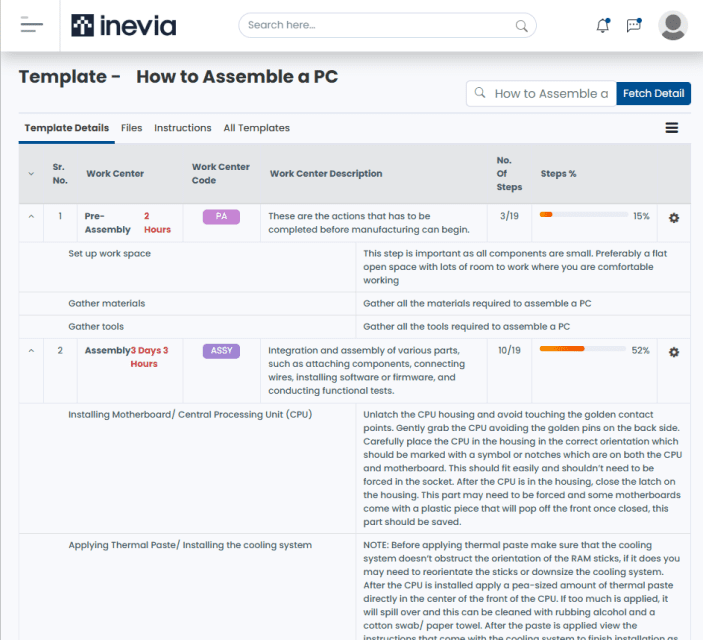
Every manufacturing process begins with a clear plan and that’s exactly what the knitting stage is all about. This is where you define the part, create a work order, and get your team aligned before production even begins. With Traveler MES, this stage becomes incredibly efficient. You can set up each job using a standardized template that includes the part’s identity defined by an 8-digit code, security level, and the appropriate work centers assigned for production. Everything is structured and centralized, reducing the back-and-forth and confusion that usually eats into valuable production time.

How it helps reduce downtime: Instead of teams losing time trying to figure out next steps or searching for missing instructions, everything they need is already documented and ready to go from the beginning. It sets the tone for a smooth, uninterrupted production cycle.

2. Product Genealogy: Serial Number Tracking and Traceability

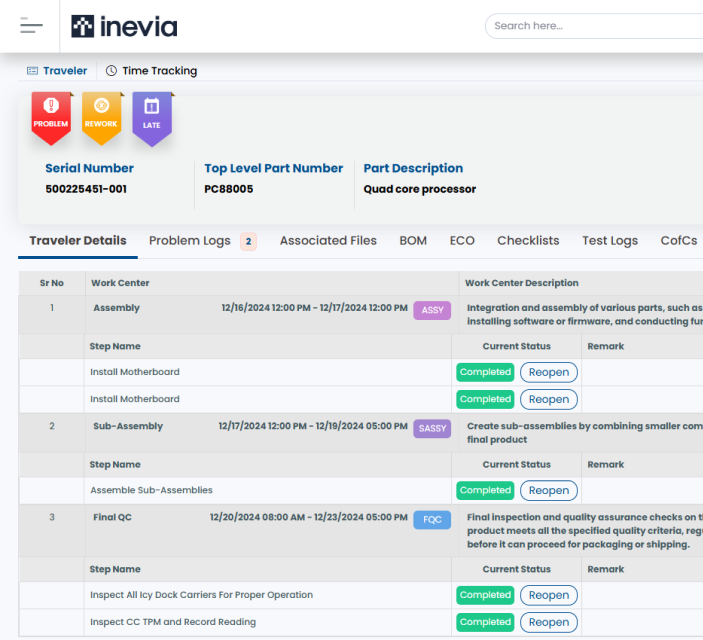
Every unit you produce carries a story. From raw material to finished product and traveler MES makes sure you never lose track of your story, With serial number tracking built right into the system, you get a complete view of each product’s journey. You can trace where it’s been, who worked on it and what exactly was done at each step in the product genealogy phase.

How it helps to reduce downtime: 

Let’s say a defect pops up later during QA or after delivery. Instead of pausing production to dig through paperwork or guess where things went wrong, you already have the full trail. That means less disruption and faster resolution.

3. Production Tracking: Live Status with Real-Time Order (RTO) Dashboards

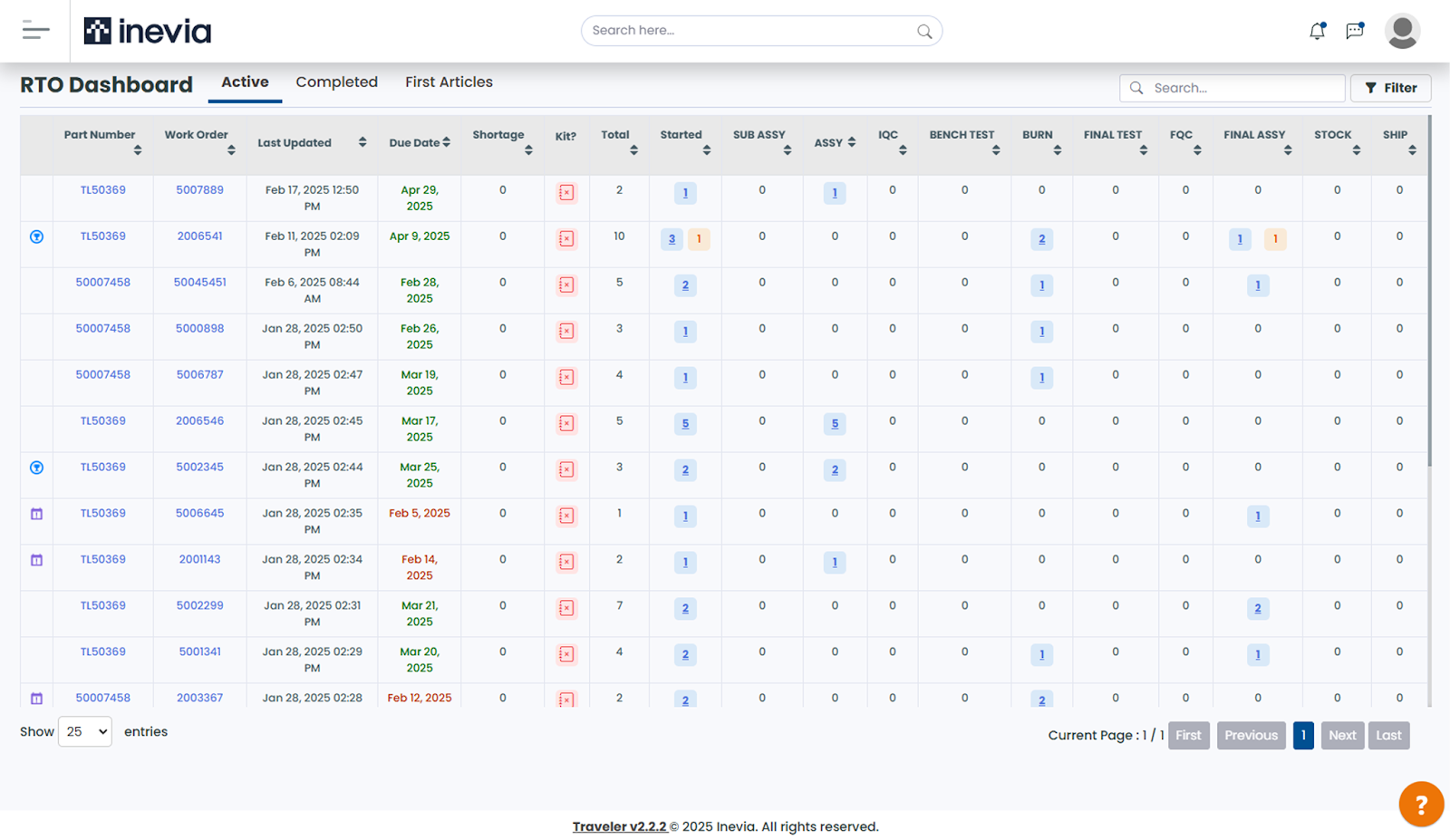
As each product makes its way through your shop floor, Traveler MES keeps you in the loop with real-time production tracking. The RTO dashboards show live updates on where every order stands whether it’s moving ahead smoothly or stuck at a work center.

How it helps reduce downtime: 

You don’t need to send someone to chase down status updates. If there’s a bottleneck or delay, you see it right away and so you can fix it before it escalates. It keeps the production line flowing without unnecessary interruptions.

4. Quality Inspection: Built-In Reporting for Immediate Action

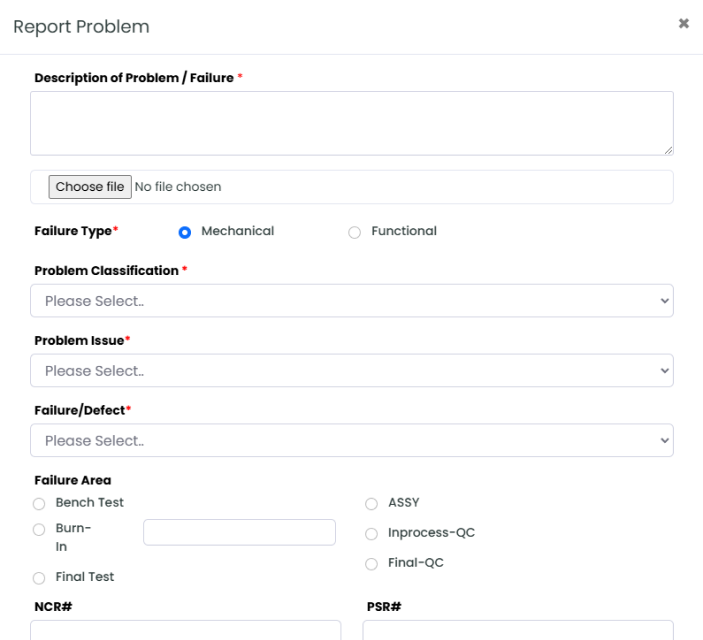
When a defect is found, timing is everything. Traveler MES enables your operators to report issues on the spot right inside the traveler document. There’s no need to stop the line or wait to fill out paper forms. Quality checks become part of the flow, not a separate task.

How it helps reduce downtime: Since problems are logged instantly, your team can act faster and avoid the snowball effect of unresolved issues. There’s no backlog of QA reports to deal with later.

5. Digital Work Instructions: Clarity at Every Step

Printed SOPs often become outdated or get misplaced, slowing down your operators and causing unnecessary errors. Traveler MES solves that with dynamic, digital work instructions. These are easy to follow, always current, and tailored to each specific task.

How it helps reduce downtime: 

There’s no more confusion or delay while waiting for clarifications. Operators get accurate, step-by-step guidance directly on their screens, so they can do the job right the first time.

6. Dashboards: Centralized Oversight for Smarter Decisions

Traveler MES doesn’t just help on the floor it empowers your leadership too. Everyone from supervisors to department heads can access dashboards customized to their role. These dashboards give a clear view of productivity, user activity, issue logs, and more.

How it helps reduce downtime:

With no blind spots, your team leads can act on real-time data rather than assumptions. They see where support is needed and can make informed decisions faster keeping production on track.

Why Traveler MES Stands Out

Unlike many traditional MES systems that feel overloaded with features you’ll never use, Traveler MES is different. It’s lean, focused, and built from real, on-the-ground manufacturing experience and not just a software wishlist. Developed in-house by a team that understands the daily challenges of discrete manufacturing, it’s designed to solve problems not create new ones.

With Traveler MES, you’re not just capturing data. You’re taking charge of your production process. Here’s what you get:

  • Full traceability of every part and every process, so nothing slips through the cracks
  • Clear, standardized workflows that guide your team step by step
  • Dashboards that reveal bottlenecks before they slow things down
  • Live production tracking that gives you confidence in your next move

See It in Action

Traveler MES is already improving production for manufacturers just like you. If you’re facing recurring delays, unclear instructions, or scattered tracking systems, this is your chance to try something that fits the way you work. Book a demo today and discover how a smarter system can lead to smoother production, fewer delays, and better outcomes for your business.

Most manufacturers are set up and running within a few days. Our team ensures your system is tailored to your workflow.

FAQs

  1. Will it disrupt my existing processes?

Not at all. Traveler MES enhances your current process and it doesn’t replace it. It integrates seamlessly into what you already do.

  1. Do we need any special hardware or ERP system?

No. Traveler MES works independently and is cloud-ready, simple to access from your existing shop-floor systems.

  1. What kind of support do we get?

Our product team is hands-on, responsive, and ready to support your floor teams, not just your IT department.